
Desk
Reporting
Trackers
Maps
Tools
Refrigerators are one of the most energy-consuming appliances in your home, accounting for up to 50% of a household's electricity consumption in Sri Lanka. Reducing the energy consumption of your refrigerator can help you save on your electricity bills and make your home more energy-efficient.

A refrigerator is one of the most energy-consuming devices in your home. According to the Sustainable Energy Authority of Sri Lanka; 30% to 50% of the electricity consumption of a general household in Sri Lanka can be attributed to the energy consumption of the refrigerator.
When it comes to household refrigerators there are two main types,
Traditional refrigerators, also known as non-inverter refrigerators, are the most common type of refrigerators found in households. They operate by using a compressor that cycles on and off to regulate the temperature inside the refrigerator. When the temperature inside the refrigerator rises above the desired level, the compressor turns on and circulates the refrigerant through the system, absorbing heat from the interior and transferring it outside. The refrigerant is then condensed and the process starts over again.
Non-inverter refrigerators have a fixed-speed compressor that runs at a constant speed whenever it is activated. This means that the compressor is either fully on or fully off, with no variation in its speed. As a result, these refrigerators can be less energy-efficient than inverter refrigerators, as they consume more energy to start and stop the compressor each time. . You might have noticed this cycle in your traditional refrigerator that at one point the unit gets quiet and then compressor works again.
To regulate the temperature inside the refrigerator, non-inverter refrigerators rely on a thermostat that controls the frequency at which the compressor turns on and off. These refrigerators are generally less expensive than inverter refrigerators, but they may produce more noise and temperature fluctuations due to their cycling compressor.
The inverter refrigerator is a type of refrigerator that has a special compressor designed to operate at varying speeds. The compressor, which is a critical component of the refrigerator that compresses the refrigerant gas and circulates it through the cooling system, is also known as the inverter itself.
What makes an inverter refrigerator different from traditional refrigerators is the fact that the compressor can run at lower speeds for longer periods of time. This is because the inverter compressor is able to adjust its speed to match the cooling demand, making it more energy-efficient than traditional compressors.
For example, if the door of the refrigerator is left open for an extended period, the compressor will detect the loss of cold air and start operating at a higher speed to compensate for the warm air coming in. On the other hand, during the night when there is less activity, the compressor will run at a slower speed, using only the energy necessary to maintain the temperature of the refrigerator.
Because the inverter compressor can adjust its speed according to the user's needs, it can save up to 20-30% on electricity bills compared to traditional refrigerators. Additionally, the inverter compressor is more durable and produces less noise than traditional compressors, making the inverter refrigerator a popular choice among consumers who are looking for an efficient, durable, and quiet cooling solution for their homes.
When comparing the energy consumption of refrigerators; the Energy Efficiency Labeling Scheme introduced by the Sri Lanka Standards Institution can be considered as the basis for the energy consumption evaluation of refrigerators. This Energy Efficiency Labeling Scheme consists of a five-star rating system where a 1-star rating represents the lowest level of energy efficiency while a 5-star rating represents the highest level of energy efficiency.
When comparing the refrigerators which are rated under Energy Efficiency Labeling Scheme; A 250-liter refrigerator with a one-star energy rating will consume around 20-25 units monthly while a five-star energy-rated refrigerator with the same capacity will consume less than 5 units monthly. Look for the energy label of the product before purchasing. It is commonly considered that the increase in one-star in the Energy Efficiency Labeling Scheme will result in a 20% reduction in the energy consumption of a refrigerator.
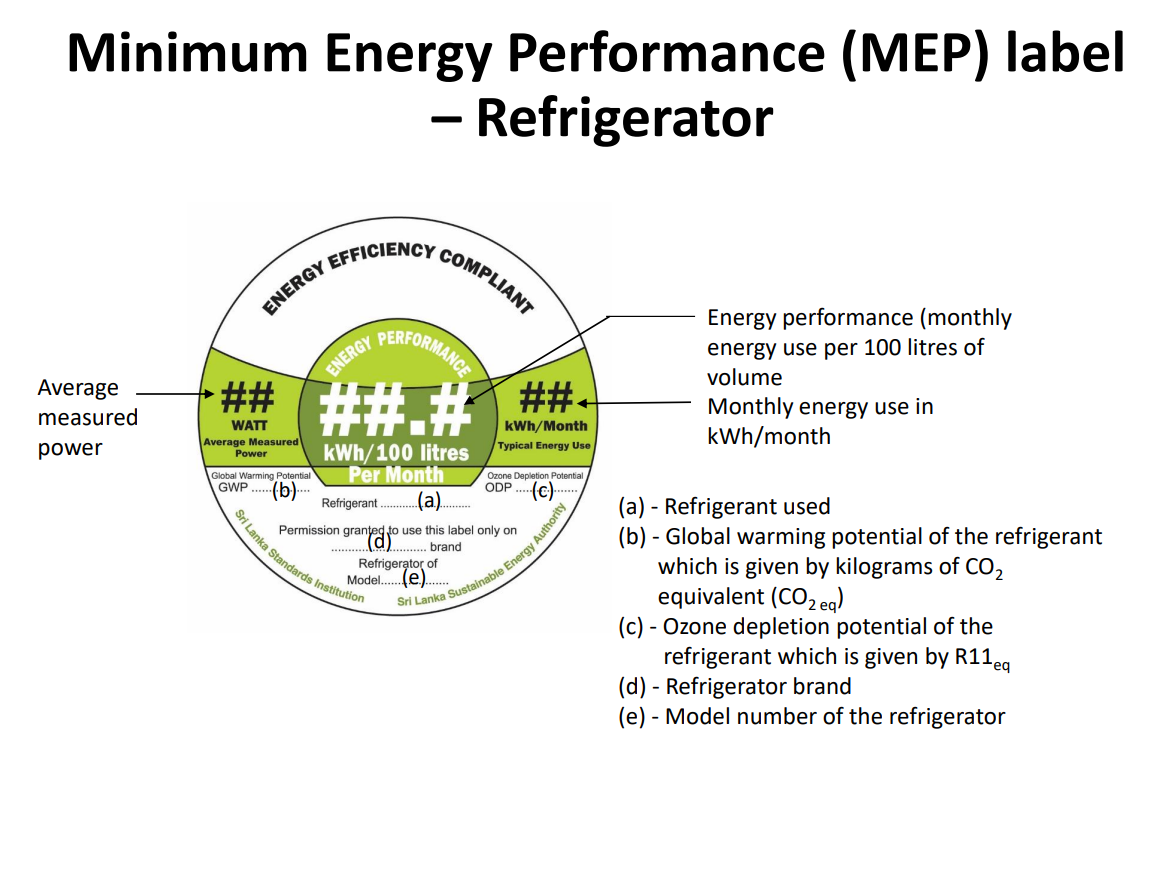
Minimum Energy Performance label - Refrigerator
Sri Lanka Sustainable Energy Authority (SLSEA)
When analyzing the relationship between capacity and energy consumption; usually refrigerators with bigger capacities consume more energy than refrigerators with smaller capacities. However, with the advancement of technologies capacity is not the only contributing factor when it comes to the energy consumption of refrigerators. With the introduction of advanced inverters, the consumption of energy can be dramatically reduced in modern-day refrigerators. Hence, it can be observed that even if the volume is doubled for a refrigerator that has a 3-star rating; the energy consumption would go up only by 20%.
The Stiker which is introduced by the Sri Lanka Regulations has been gazetted on mandatory energy labeling for CFLs, Ceiling fans, and LED lamps. For computers and refrigerators, voluntary labeling programs are in operation.
The recommended 100L energy performance for a good refrigerator will depend on the energy efficiency rating of the specific model. In general, the lower the energy consumption per 100 liters of volume, the more energy-efficient the refrigerator is and the less it will cost to operate.
As a rough guide, an energy-efficient refrigerator may consume around 0.2 to 0.3 kWh per day per 100 liters of volume. This means that for a 100-liter refrigerator, the monthly energy use would be between 6 and 9 kWh per month.
However, it's important to note that the actual energy consumption will vary depending on factors such as the model, usage habits, and environmental conditions. Additionally, larger refrigerators may have a slightly higher energy consumption per 100 liters of volume.
Usually, it is highly argued whether going for a new refrigerator is worthwhile or not. It is considered that the energy consumption of a particular refrigerator will go up by 10% every five years. Sri Lankans do not replace their refrigerators until the old one is broken, It is entirely possible that you have a refrigerator in your home 15 to 20 years old, since the usual life span of the refrigerator is around 20-25 years. As a result of this, you may have a refrigerator that has its power consumption increased by around 30-40% by now. Additionally, when comparing the technologies used for the old refrigerator with the novel refrigerators, The new ones have better technology behind them therefore, A new refrigerator with the same capacity will consume way less energy than your old refrigerator.
For example, Let's consider a normal two-door refrigerator with a capacity of 250 liters which was manufactured in 2010.
However, not very efficient, a modern two-door refrigerator with a capacity of 250 liters would only have an electricity consumption of 20 units per month. Hence the user of the old refrigerator will additionally pay for 28.4 units (48.4 units - 20 units).
If you consume 100 units a month, You will pay an additional cost of Rs. 1,675.60 (28.4 units*Rs. 59) compared to a new refrigerator.
As discussed in this article above;it would be ideal for you to go for a new refrigerator when it comes to energy efficiency. However, energy efficiency may not be the only fact that you should consider when making a purchasing decision with regard to a refrigerator in Sri Lanka.
Even though you decide to purchase a new refrigerator to reduce the electricity cost; the cost of refrigerators may raise your eyebrows as well. The cost of a normal two-door refrigerator with a capacity of 250 liters - 300 liters ( (suitable for a household with 4-5 members) may vary from 120,000 LKR to 260,000 LKR.
So following are some tips for you to reduce the electricity consumption of your refrigerator.
Storage tip: Cover products with polythene wrap before putting them in the fridge. Keep liquids in tightly-sealed containers.
Choose a refrigerator that will meet the needs of the house. Refrigerators with high capacities consume more energy. As previously discussed in this article refrigerators with higher capacities are more energy efficient than refrigerators with smaller capacities. However, for a household that is focused on controlling the monthly electricity bill, it is not worthwhile to go for a refrigerator with an extra capacity.
Minimize the number of times the refrigerator door is opened. The amount of electricity used will increase if hot air enters the refrigerator.
Keep the refrigerator's backside out of direct sunlight and away from hot air.
To ensure that the rear of the refrigerator has adequate ventilation, provide a 10-inch space between it and the wall.
Keep the coils at the rear of the refrigerator free of dust and check the fan vent. The compressor works harder and consumes more electricity when the coils are dirty.
In conclusion, it is pretty obvious that normal households will have to incur a considerable additional cost in using the refrigerator with the recent tariff hike. If you currently own a relatively new refrigerator with a decent energy efficiency rating; it is recommended to try and reduce the unwanted energy consumption of the refrigerator, the above-mentioned tips might help you.
However, it would be a good idea to buy a new one if you are using an old refrigerator since it would have a direct impact on the monthly cost considering the new electricity charges. The initial investment of purchasing a new refrigerator is a considerable one, you could try to buy one on an installment basis. The fact of the matter is, If you didn’t buy one, you would be paying a significant portion of your monthly installment to CEB as your electricity bill anyway.