
Desk
Reporting
Trackers
Maps
Tools
Numbers.lk pre election poll results once again proved accurate in predicting the Presidential Election outcome. Numbers.lk’s final poll, conducted between the 9th and 16th of September, and published on the 18th, estimated Anura Kumara Dissanayake (AKD) would receive 40% of the vote, while Sajith Premadasa was predicted to secure 29%.
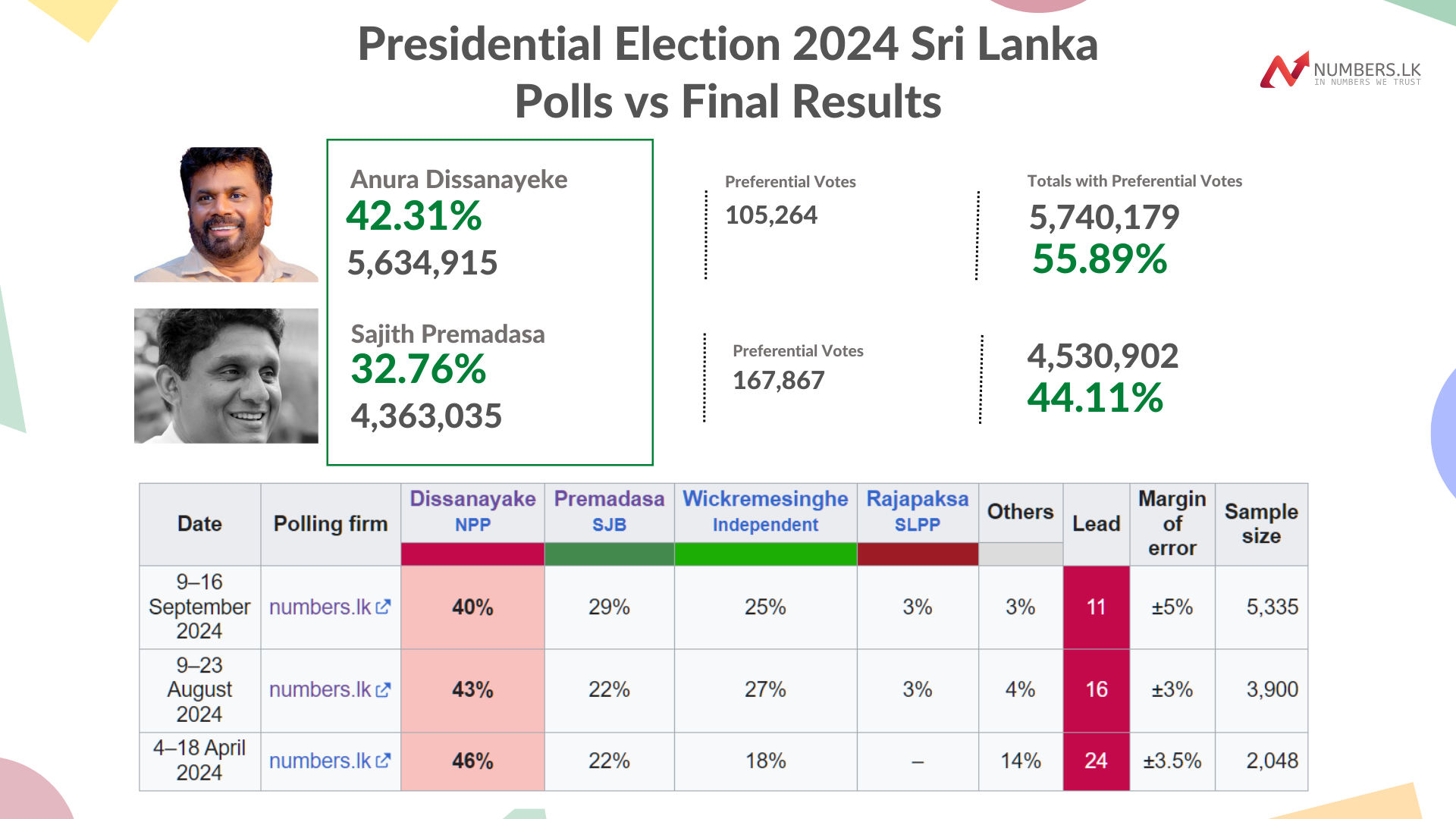
For the second presidential election in a row, Numbers.lk has demonstrated remarkable accuracy in polling Sri Lanka’s electorate, successfully predicting the race’s outcome within the margin of error for the top two candidates. Numbers.lk’s final poll, conducted between the 9th and 16th of September, and published on the 18th, estimated Anura Kumara Dissanayake (AKD) would receive 40% of the vote, while Sajith Premadasa was predicted to secure 29%.
📊 Final NumbersLK pre-election poll results are in! 🇱🇰 🗳️
— Numbers.lk (@numberslka) September 18, 2024
🧭 AKD - 40%
☎️ Sajith - 29%
🐘 Ranil - 25%
🌷 Namal - 3%
❔ Undecided - 1%
Sample: 5,335 adults
Period: Sep 9-16
Margin of error: +/- 5.0%
more: https://t.co/wB5Oki9x7b pic.twitter.com/m5o6oJaBCT
These results are well within the margin of error of +/- 5%.
The distinction between polling and predicting election outcomes is crucial. Polls provide a snapshot of public opinion at a specific moment, capturing voters' preferences during the polling period. In contrast, predictions are broader estimates, often based on various techniques, models, and sometimes even gut feelings. While anyone with access to sufficient information can attempt a prediction, polling relies on scientifically gathering data from representative samples of the electorate.
In the case of Numbers.lk’s final poll, the results diverged slightly from the actual outcome. This is not uncommon, as polls capture voter sentiment during the polling window, while actual voting behavior can shift, particularly in the final days leading up to the election.
One well-documented trend is the phenomenon of voters shifting their support from third-party or independent candidates to the top contenders in the final days before the election. This behavior is seen globally, where voters who initially support a third-party candidate may ultimately switch to one of the top two candidates in an effort to prevent a candidate they oppose from winning.
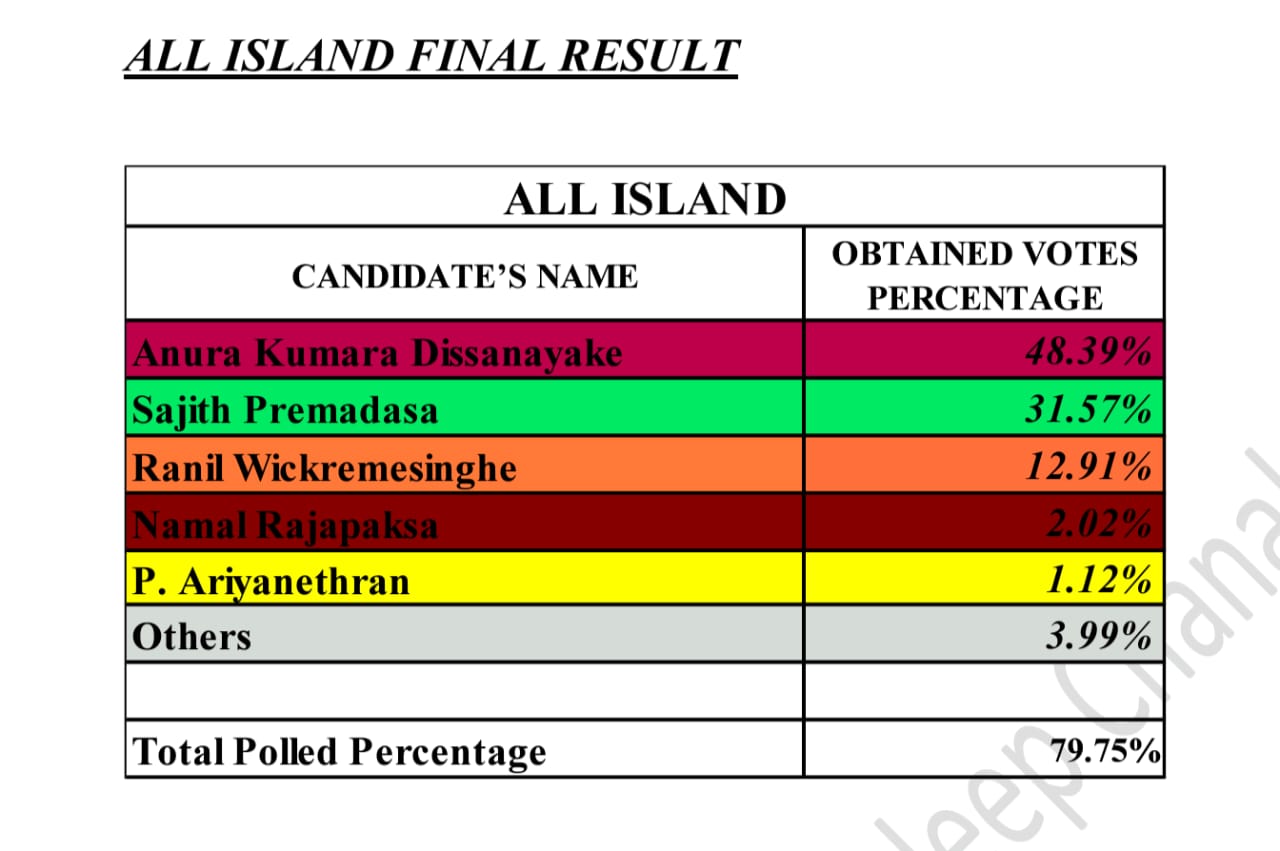
This pattern may have played a role in the 2024 Sri Lankan presidential election as well. In our final poll, Ranil Wickremesinghe was projected to have 25% support, but he ultimately received only 17.27% of the vote. The fact that both Anura Kumara Dissanayake (AKD) and Sajith Premadasa outperformed their polling numbers by 2-4 percentage points suggests that a portion of voters may have shifted their support from Ranil Wickremesinghe to one of the top two candidates in the final days.
This discrepancy between polling and actual results might not indicate a polling error, but rather the possibility of voters changing their minds at the last moment. Our poll was conducted between the 9th and 16th of September, while the election took place on the 21st.
This dynamic can be seen in numerous elections worldwide, including U.S. presidential races, as highlighted in research by the Pew Research Center.
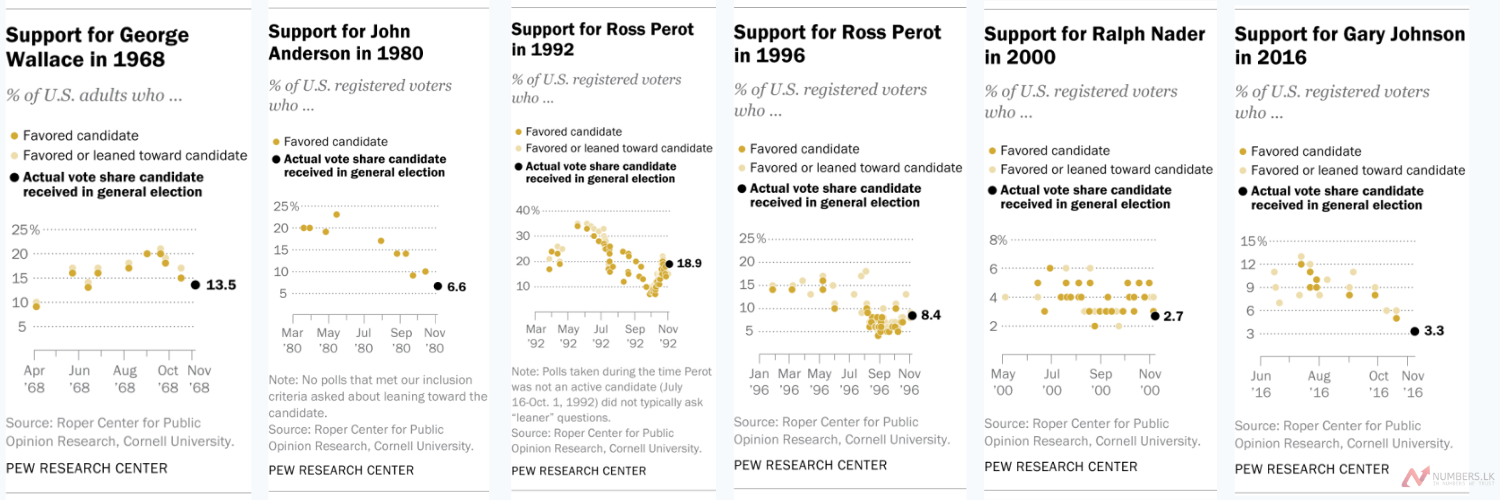
"U.S. political history tells us that third-party and independent candidates usually finish a lot lower than where they start. Not only did support for third-party and independent candidates tend to decline over the course of their campaigns, but their vote shares often came in lower than polls suggested they might."
Pew Research Center:https://www.pewresearch.org/short-reads/2024/06/27/third-party-and-independent-candidates-for-president-often-fall-short-of-early-polling-numbers/
This last-minute shift was also evident in the 2019 Sri Lankan presidential election, where the final poll showed 5% support for AKD. However, on Election Day, AKD only garnered 3% of the vote, with much of the missing support seemingly going to Premadasa.
Here we are, the Election Day!. This is our final prediction of the Results.
— Numbers.lk (@numberslka) November 15, 2019
Gotabaya Rajapaksha 🌷- 52.74%
Sajith Premadasa 🦢- 38.12%
Anura Kumara Dissanayake 🧭- 5.2%
Mahesh Senanayake 💡- 1.73%
Others - 0.8%#PressPollSL #lka pic.twitter.com/pimbcicRCW
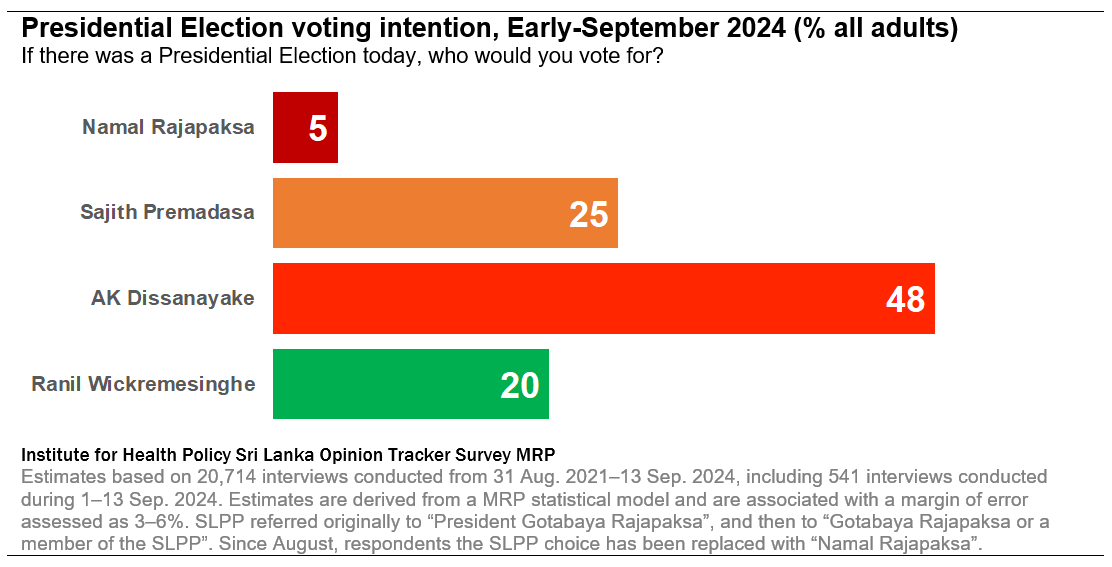
In addition to Numbers.lk, other polling agencies, such as the Institute of Health Policy (IHP), conducted their own surveys. The IHP’s final poll, conducted through phone interviews, also sought to capture voter sentiment. However, IHP revised its initial model due to what it identified as a "social desirability effect," where respondents over-reported their support for AKD. This adjustment may have introduced additional error into their numbers, underscoring the difficulty in capturing voter intent, especially when societal factors influence responses.
Moreover, other independent analysts, like Pradeep Chanaka, released predictions for each polling division. His predictions were mostly accurate in 2019; however, this year they tended to overestimate support for AKD while underestimating votes for Premadasa and Ranil Wickremesinghe. These deviations highlight the inherent challenges of predicting tight, multi-way races.
The key to Numbers.lk’s success lies in its comprehensive approach. Instead of merely asking respondents whom they plan to vote for, the team gathers multiple data points, including perceptions of other candidates, favorability ratings, and rejection rates (i.e., candidates voters would never support). By also considering family voting patterns—such as how respondents’ partners or parents intend to vote—the team gains valuable insights that help gauge public support more effectively.
As an online poll, Numbers.lk also takes extensive measures to guard against manipulation by campaigns attempting to skew the results. Through creative and technical methods, the team ensures the dataset remains clean and representative.
The importance of public polling cannot be overstated. In developed countries, polls are often used not only to gauge election outcomes but to influence policy decisions and gauge public support for various initiatives. In Sri Lanka, the expansion of reliable public opinion polling could provide policymakers with valuable insights into the public's views, helping them adjust their approaches as needed.
Numbers.lk’s accurate polling in two consecutive elections demonstrates the potential of data-driven analysis to reflect voter sentiment and enhance the understanding of electoral dynamics in Sri Lanka. As the country moves forward, the need for more robust and transparent public polling will be critical for the health of its democracy.